Case note · Website and GEO
Tuoluren / GEO Studio — the agency site, audited in public
The corporate site for our own GEO practice: company facts, services, 40+ articles, and an unusually complete machine-readable layer. We asked an AI assistant to review it layer by layer, and we are publishing the result in full — including the parts it marked as weak.
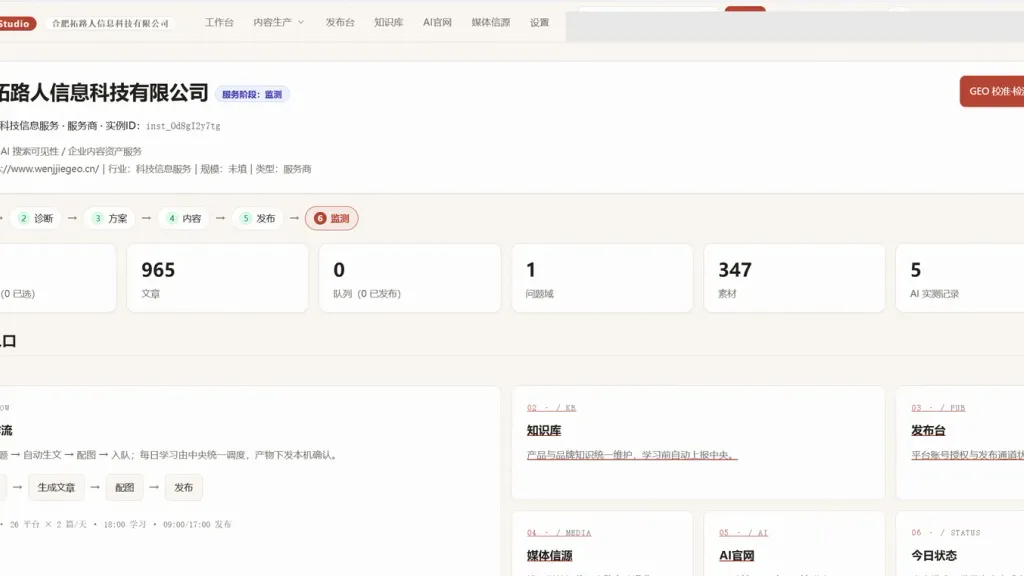
What the review looked at
Six layers, from whether crawlers can reach the site up to whether the results hold.
The six-layer assessment
Reproduced and translated from the review of 2026-10-12. Ordered from the foundation upward: can it be crawled, can it be understood, is it worth quoting, and does the result hold up.
- Layer 6
Outcome verification
weakSelf-reported only. Brand mention rates such as 10/15 are the site’s own measurements — no third-party and no cross-time re-test.
- Layer 5
Authority and entity consistency
strongCompany facts are consistent across JSON-LD, llms.txt, index.md and the FAQ. The site also confronted an attribution problem head-on: AI assistants had assigned a related app to five different companies.
- Layer 4
Content coverage
strongMore than 40 continuously updated articles, aimed precisely at the questions AI users actually ask (cost, time to effect, who is best, who is best locally). Includes a methodology white paper, reading of a published group standard, anonymised cases and measurement data.
- Layer 3
Structured data
partialOrganization and WebSite JSON-LD site-wide. Gap identified: article pages were missing Article / NewsArticle markup.
- Layer 2
AI protocol layer
leadingllms.txt and llms-full.txt, a markdown index, ai/summary + faq + service JSON, openapi.json, an MCP server card with a /mcp endpoint, an agent-skills index with sha256 digests, and RSS.
- Layer 1
Technical crawlability
solidrobots.txt allows more than 30 AI crawlers one by one rather than by default — including GPTBot, ClaudeBot and PerplexityBot, plus the Chinese assistants Doubao, Kimi, DeepSeek, Wenxin, Tongyi and Yuanbao. Two sitemaps, canonical tags throughout.
The review’s own conclusion: the protocol layer is in the first tier of domestic peers; the outstanding items are article-page schema, external verification of results, and consolidating earlier articles that repeated the same topic.
What the review singled out
Three things it said most agencies claiming to do this work do not have on their own sites.
AI protocol layer
llms.txt, markdown index, three machine-readable files, MCP server card, agent-skills index
Content strategy
40+ articles written to match the questions people actually ask an assistant
robots.txt
30+ AI crawlers allowed explicitly by name, not left to a wildcard
Why the weak layer is on this page
A vendor quoting only the praise is selling, not reporting
Dogfooding, including the red marks
The methods we sell were applied to our own site first, and the audit of that effort is published without edits.The standard has to apply to us first
We tell clients a visibility claim has to trace back to records somebody else can check. The review gave our own outcome numbers the lowest score for exactly that reason, so it stays visible here.
Self-assessment is a starting point, not a result
The honest use of a tool like this is to find your own gaps. It found ours: article markup, and no external re-test over time.
Public gaps get fixed faster
Publishing the deficiency list creates the pressure to close it. Two of the three items the review raised were actioned the same week.
Want your own site audited the same way?
We will run the six layers against your site and show you the raw findings, including the layers you fail.That is more useful than a score.